Four workforce questions that turn business strategy into a plan

Four workforce questions that turn business strategy into a plan
How TalentNeuron connects workforce intelligence to business decisions


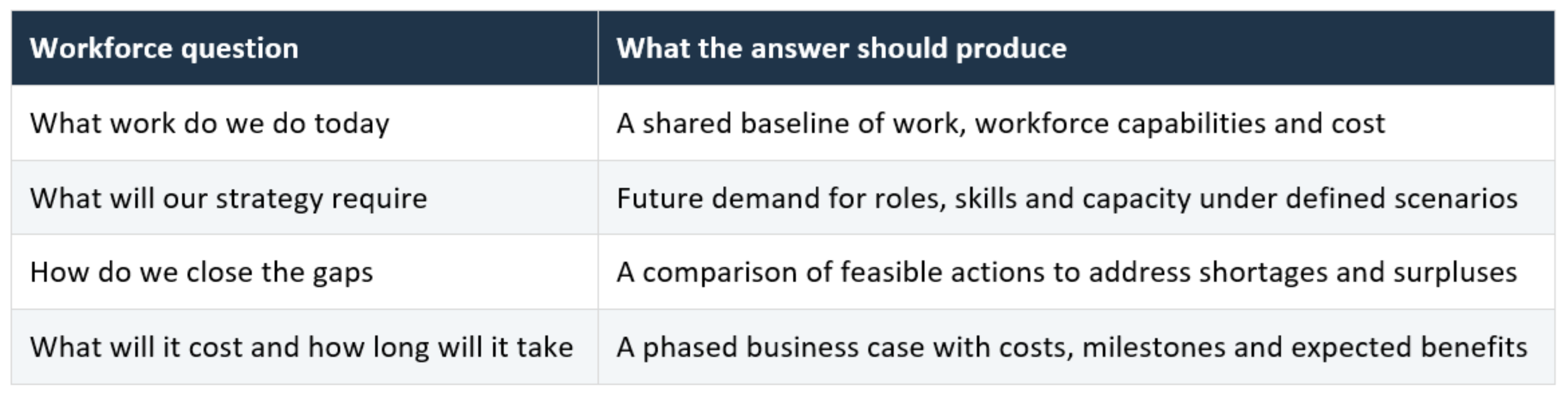
A strategy to grow revenue, enter a new market or deploy AI creates a set of workforce decisions:
- What work will change?
- Which capabilities will we need?
- Where will they come from?
- What will the transition and "end state" workforce cost?
Each answer changes the others. A hiring plan that looks sensible on its own may become unaffordable, too slow, or even unnecessary once you consider reskilling, location and automation together.
TalentNeuron helps leaders work through four connected questions, combining internal workforce data with external labor market intelligence. The result is a workforce plan whose assumptions, choices and financial implications can be examined together.
You can start with one strategic priority and the workforce segments most important to it. A useful first plan makes assumptions visible and shows where better evidence would change a decision. Detailed work mapping can develop alongside it.
1. The work and workforce of today
What work do we do today, and who does it?
Where it breaks down
Most enterprises can report headcount by cost center. Understanding the work behind those numbers is harder. Titles vary across regions and acquisitions. Skills data uses different definitions in different systems. Tasks are often missing entirely.
The distinctions matter. A role groups responsibilities. Tasks describe the work to be done. Skills enable someone to do that work, proficiency describes how well, and capacity describes how much work can be delivered in a given period.
How TalentNeuron helps
- Establish a common language. We normalize roles and skills across the organization and map them to market benchmarks, supported by a library of 65,000+ skills. HR, Finance and business leaders can then compare equivalent work across teams and locations.
- Map the work behind the role. Our task libraries provide a starting model of the activities within a role. Operational evidence and validation with the business establish which tasks are actually performed and how much time they consume.
- Build skills profiles with visible evidence. We bring together existing employee records and inferred skills. Through our expanded CodeSignal partnership, clients can add proficiency evidence from assessments and evaluation of real work. That helps distinguish a likely skill from demonstrated capability.
- Put the baseline in market context. We segment the workforce by role, skill, location, talent segment and demographics, then compare its composition, skills and pay with relevant competitors and labor markets.
What success looks like
HR, Finance and the business work from one agreed baseline. Leaders can see where definitions are reliable, where evidence is thin, and which work deserves closer examination. Workforce discussions start with decisions rather than data reconciliation.
2. The work and workforce our strategy requires
What work and workforce will our business strategy require?
Where it breaks down
A target to grow revenue by 20% does not translate automatically into 20% more employees. Demand depends on workload, productivity, the operating model and the work the strategy adds or removes. AI changes those relationships, task by task.
McKinsey estimates that currently demonstrated technologies could theoretically automate activities accounting for about 57% of US work hours. That is a measure of technical potential across automation technologies, including agents and robots. It is not a forecast of job losses or realized savings.
How TalentNeuron helps
- Translate business targets into workforce demand. Driver-based models connect targets such as production volume, customer growth or new locations to roles, skills and headcount, using assumptions about workload and productivity. Leaders can see how changing a business assumption changes the workforce requirement.
- Assess how technology could change the work. Task-level automation analysis identifies exposure to automation and augmentation. Adoption, workflow redesign and implementation timing become planning assumptions, so technical potential can be tested against a realistic operating scenario.
- Define future capabilities. We combine skills trajectories, competitor hiring signals and future role profiles to identify capabilities likely to grow, decline or emerge. The plan can account for new work, including oversight and management of AI-enabled processes.
- Test where capacity can come from. We assess talent availability, cost and hiring difficulty across locations. Automation can be modeled as a capacity option alongside people, with explicit assumptions about effective output, cost and human oversight.
What success looks like
Future demand is expressed in roles, skills and capacity tied to strategic priorities. Leaders can inspect the assumptions behind it and compare scenarios as growth, productivity or technology adoption changes. Scarce skills are identified before the hiring plan depends on them.
3. The gaps and the choices for closing them
How do we get from where we are to where we need to be?
Where it breaks down
Comparing future demand with today’s workforce misses half the problem. People will leave, retire, develop and move. Contracts will end. The workforce available when the strategy needs it will be different from the workforce on the payroll today.
Consider a hypothetical engineering team. It has 100 engineers today and expects to need 130 in three years. If departures leave 90 available at that point, the gap is 40. Planning only for the 30 additional positions would leave part of the requirement uncovered. Automation may also play a role in reducing that need. Future workforce planning needs to account for “all of the above.”
How TalentNeuron helps
- Forecast future internal supply. Our workforce planning solution models future talent availability using internal data and assumptions such as attrition and retirement. The plan can account for contract end dates, internal movement and development, then compare projected supply with demand by role, location and time.
- Compare ways to close the same gap. Build means developing or redeploying existing talent; buy means hiring; borrow means using contractors or managed services; bot means automating suitable work. We bring internal workforce evidence and external market intelligence into the comparison, so feasibility, cost and timing can be assessed together.
- Make internal development a practical option. Skills adjacency shows where employees’ existing capabilities provide a starting point for future roles. Gap analysis, career pathing and internal mobility help identify candidates and prioritize development, with proficiency and readiness informing the decision.
- Redesign the work as well as the workforce. Organizational design, role redesign and process changes can address shortages or surpluses. Leaders can also test whether simplifying a service, removing low-value activity or stopping lower-priority work reduces the gap. And of course, whether AI, agents or industrial automation could become part of the workflow. These choices aren’t just linked to AI initiatives; they can be critical during restructuring and M&A as well.
What success looks like
Leaders have a feasible mix of actions with explicit dependencies, owners and target dates. Hiring and development are evaluated against the same requirement. Surpluses receive as much attention as shortages, and choices are revisited as the assumptions change. Everyone works from the same shared understand of demand and supply forecasting, and automation potential.
4. The cost and time required to deliver the plan
What will the transition cost, how long will it take, and what will the future workforce cost to run?
Where it breaks down
A lower future salary bill does not tell you whether a transition is affordable or when it will pay back. Training, implementation, temporary overlap and technology costs can arrive before benefits do. Hiring speed and time to proficiency can determine whether the strategy is achievable on schedule.
Bain’s 2026 survey of 951 companies found a gap between expected and realized AI cost savings. Its analysis highlights how workforce changes can lag workflow redesign, leaving anticipated value unrealized. A business case needs to explain how benefits will actually be captured.
How TalentNeuron helps
- Attach costs to workforce scenarios. We combine internal workforce and cost data with external pay benchmarks by role and location. Our data foundation includes more than one billion salary data points, helping Finance test market assumptions alongside internal rates.
- Separate transition costs from ongoing costs. Scenario comparisons give Finance a basis to test client assumptions for development, recruiting, implementation, temporary overlap and workforce exits. Ongoing labor and technology costs should be considered alongside expected benefits, with their timing made explicit.
- Model the time the time to productivity. Talent supply, demand and time-to-fill benchmarks inform external hiring plans. Internal development and productivity ramp-up require business assumptions. A faster start date can still produce a later delivery date if proficiency takes longer to develop.
- Track results against the approved plan. Monitoring compares updated workforce and cost data with planned FTE and cost to identify drift. APIs and data feeds support integration of workforce intelligence into existing systems and Finance models. Action owners use that evidence to adjust execution and revisit assumptions.
If automation releases 20% of a team’s time, the plan must say what happens next. The capacity might absorb growth, improve service, reduce overtime or avoid future hiring. A reduction in operating cost needs a corresponding action. Count the same productivity benefit only once across demand and supply assumptions.
What success looks like
Finance and HR defend the same numbers in the same meeting. Each scenario shows transition investment, ongoing costs, milestones and expected benefits. Leaders can see which assumptions drive the result, which actions are required, and where actual workforce costs or capacity are moving away from the plan.
Keeping the four answers connected
These questions share a foundation, but the answers keep changing. A new growth target changes demand. Attrition changes supply. A slower hiring market changes the feasible options. Delayed AI adoption changes both timing and cost. The plan needs to show those effects together.
Answering each question in separate tools creates an analytical tax. Skilled analysts spend time reconciling definitions and assumptions across systems while the business waits for a decision.
TalentNeuron is a Workforce Intelligence Platform. We connect internal workforce data with global labor market intelligence and use common definitions of roles, tasks and skills across the planning process. Our consulting team helps clients establish the baseline, assumptions and governance needed to begin, then develop the approach as their planning matures.
The platform supports updates as workforce data and market signals change. HR, Finance and the business agree who owns the assumptions, when they are refreshed and which deviations trigger a new decision. Clients can use the platform, APIs and data feeds to bring the intelligence into the way their teams already work.
The question to take into your next leadership meeting is straightforward: Can we trace our workforce investments back to the strategy, explain the alternatives we considered, and show whether the plan is delivering? If you can’t, where are you struggling the most?

Every Workforce Plan Is a Bet on Skills. How Defensible Is Your Employee Skills Data?

The Prerequisite Trap: Why Strategic Workforce Planning Has to Come Before Work Redesign