
When the Industry Starts Naming a Problem, It's Usually Close to Solving It
.svg)
When the Industry Starts Naming a Problem, It's Usually Close to Solving It


For years, Talent Intelligence, Skills Intelligence, and Work Intelligence were treated as separate markets. They're not.
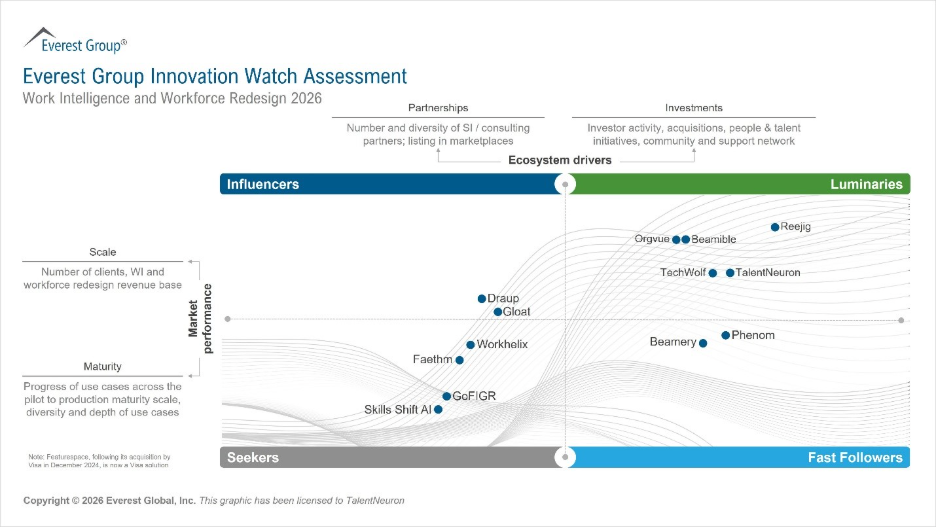
This month, TalentNeuron received two significant recognitions from Everest Group: a Leader designation in the PEAK Matrix® for Skills Intelligence (2026) and a Luminary designation in the Innovation Watch Assessment for Work Intelligence & Workforce Redesign (2026).
Coming so soon after Lighthouse Research & Advisory named TalentNeuron the sole "Best-in-Class" winner in Talent Intelligence earlier this year, it seems that the industry is coming to the same conclusion that we have: Talent Intelligence, Skills Intelligence, and Work Intelligence are not separate markets but layers of the same problem.
Being recognized as a leader in all three of these categories is incredibly gratifying. We’re the only vendor with a leading solution across all three spaces at a time when these markets are coalescing into something more meaningful and consequential than any individual solution category alone.
New questions for a new age
This is the decade that broke workforce planning as it was practiced.
Organizations spent decades building talent intelligence: understanding labor market dynamics, tracking competitor hiring, reading supply and demand signals. That foundation still matters, but market intelligence alone doesn't answer the questions that are actually at the core of strategic planning, especially in an environment this volatile.
Skills Intelligence was the next level: moving from "what's happening in the market" to "what capabilities do we need to compete." But even that isn't sufficient. Skills don't exist in isolation. They live inside tasks. Tasks live inside roles. And roles are being reshaped — by AI, by shifts in business strategy, by changing economic conditions.
The question most executives are actually wrestling with isn't "how do we find talent" or even "how do we plan for it." It's more fundamental: “Do we have the workforce required to execute our strategy, and if not, where will we have gaps?” And perhaps most importantly, “Will we understand our gaps with enough clarity and lead time to do something about them?”
Most organizations can't answer that confidently. Not because they lack data, but because the data they have doesn't connect. Workforce planning lives in one system. Skills data lives in another. Labor market intelligence sits in a third. Automation impact assessments happen, if at all, as consulting engagements that are already aging the moment they're delivered.
Workforce Redesign is where that chain of reasoning concludes. Given everything we know about the market, our people, and the nature of work itself, what's next?
The Everest Group recognition, particularly in Work Intelligence & Workforce Redesign (a category that is still being defined) reflects a market that is starting to name this problem more precisely. That’s important, because naming a problem clearly is usually the first step toward solving it.
What we've built, and where we're going
The capabilities Everest evaluated are live and serving TalentNeuron's global customer base today. We have a unified skills library spanning 65,000 normalized skills across 142 countries, automation impact analysis at the task and role level, scenario-based strategic workforce planning grounded in live labor market data, and the ability to connect internal workforce data to external market intelligence in a single planning model.
From that foundation, we're building what we believe is a fundamentally different category of solution: a workforce intelligence platform that doesn't just support planning but actively orchestrates the downstream systems where the plan becomes real. Workforce plans that push relevant requisitions into the ATS. Reskilling requirements that translate into learner-specific paths in the LMS. Monitoring that tracks whether the plan is actually working, in real time and at every level of the organization. All fed and informed by dynamic, always-on, market and competitor intelligence.
Asking the harder question
The value of spanning Talent Intelligence, Skills Intelligence, and Work Intelligence & Workforce Redesign reflects how workforce decisions actually get made. You cannot redesign work without understanding what skills are available in the market. You cannot plan intelligently without knowing how automation is reshaping the tasks inside the roles you're planning for. And you cannot execute any of it without a shared model that connects HR, Finance, Strategy, and business leadership to the same underlying reality.
That's what we've already built and what we’re continuing to evolve and develop. This recognition confirms we're building it in the right direction.
If you're evaluating workforce intelligence solutions, look past the category labels. Ask the harder question: “Does this solution solve *part* of the problem or does it solve the actual problem?” With the right technology investment, you can navigate the current state of disruption while building the long-term foundation for data-driven workforce transformation and durable competitive advantage.
Read Everest Group's Skills Intelligence Platforms PEAK Matrix®
Read Everest Group's Work Intelligence and Workforce Redesign Innovation Watch Assessment
.png)
From a Single Task to the Whole Organization: Making Automation Potential Measurable
.png)
From Job Architecture to Work Architecture: Designing Roles for the Age of AI
.png)