
I don't know what to call this anymore. Maybe you do.
.svg)
I don't know what to call this anymore. Maybe you do.
.png)

I have a category-naming problem.
For a while, we described TalentNeuron as a Workforce Intelligence Platform. That was accurate, but incomplete. Intelligence is a critical part of what we do, but it sounds like the destination is an insight, a dashboard, or a better answer to a research question.
More recently, I have used System of Planning to distinguish strategic workforce planning from headcount budgeting and from the systems of record that dominate the HR technology landscape. That language gets closer. But it still implies that the plan is where the work ends.
It isn't.
What we have already built – and what we are rapidly maturing – connects external and internal workforce intelligence to demand and supply forecasting, gap analysis, scenarios, and financial choices. It turns those choices into specific interventions. It will increasingly orchestrate approved work into the HRIS, ATS, LMS, talent marketplace, and other systems where execution actually happens. Then it monitors what was done, what changed, and whether the original assumptions held – and feeds that evidence back into the plan.
Insight → Planning → Action → Monitoring → back to Planning.
This is more than workforce intelligence. It is more than a system of planning. And it is certainly more than another HR dashboard with an AI layer on top.
The term I keep coming back to is Workforce Decision System.
I am not fully convinced it is the right name. “Decision system” can sound clinical. It can also imply that the technology makes the decision, when the real purpose is to give HR, Finance, Technology, and business leaders a shared body of evidence, a set of modelled choices, and a governed path from decision to action.
So rather than declare a new category and hope the language sticks, I want to open the conversation and ask the people who actually do this work: what would you call it?
Where I’m stuck: the language has not caught up with the architecture
“System of Planning” still describes the middle of this architecture well. It sits above the systems of record – not to replace them, but to do the thing none of them can: hold the outside world and the inside of the organization in the same model, at the same level of granularity, under the same definitions; translate strategy into a time-phased view of workforce demand and supply; and turn the resulting choices into targeted interventions.
Headcount planning starts from an approved number and works backward to affordability. Strategic workforce planning starts from business strategy and works forward to feasibility.
But the mature form cannot stop with a plan. It must connect that plan to the systems of execution, observe the results, and use what happens to sharpen the next decision.
The architecture is best understood as three core stages plus a continuous fourth motion:
- Insight: the external and internal signals that reveal what is changing.
- Planning: the models and choices that define the workforce the business will need.
- Action: the interventions that close the gap and the orchestration that moves approved work into execution.
- Monitoring: the evidence that shows whether the actions occurred, whether they worked, and what the next version of the plan needs to change.
That structure matters. The stages have a clear direction, but they are not a one-way waterfall. Weak intelligence makes sophisticated planning confidently wrong. A plan with no action path is just a presentation. Action that loses the plan's logic in the handoff becomes disconnected activity. And action without monitoring leaves no way to tell whether the capability gap is actually closing.
The point of the architecture is continuity: external and internal signals → time-phased decisions → targeted execution → observed results → a better next decision.
What the simplified architecture looks like on a slide
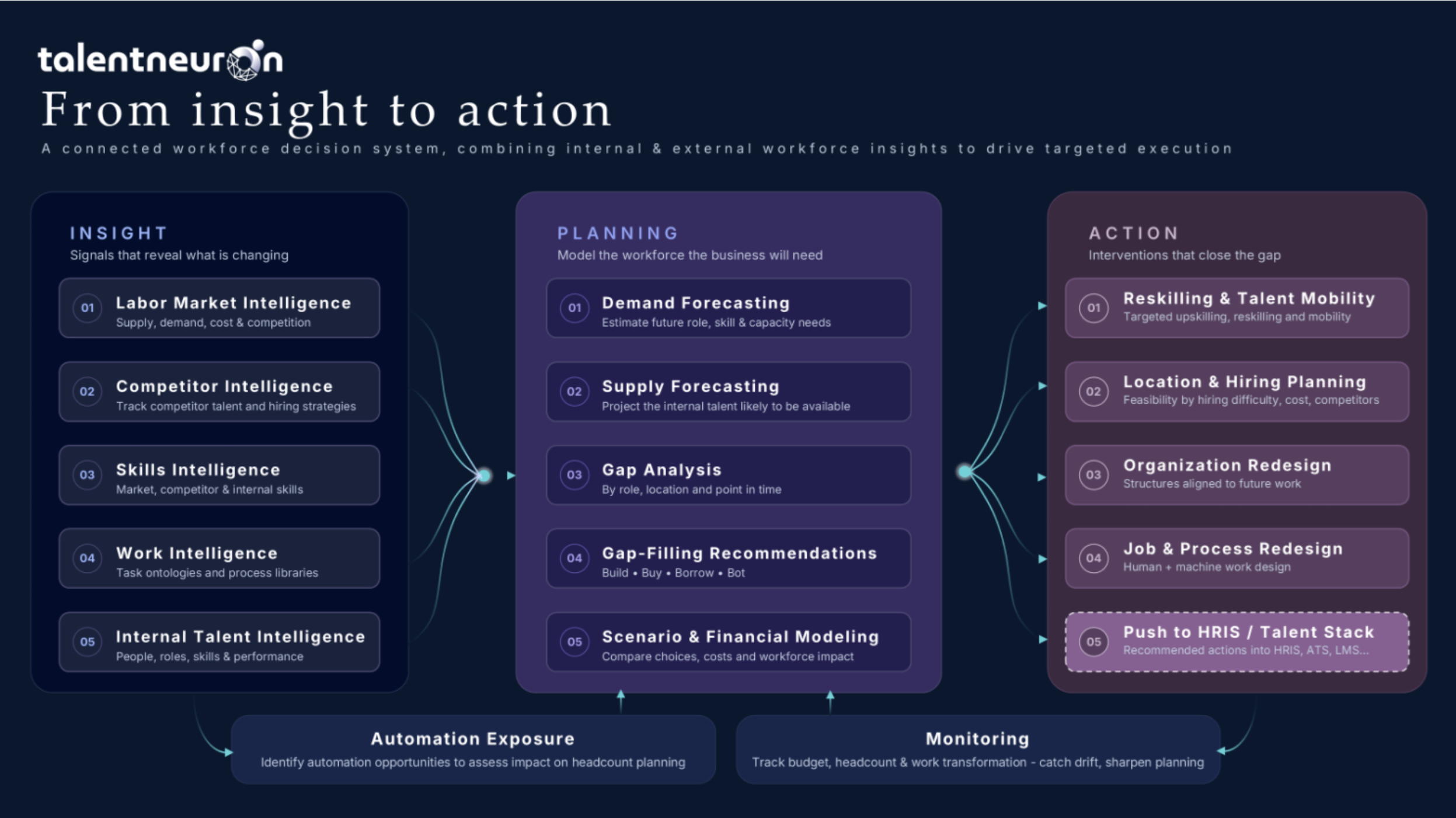
01 Insight: signals that reveal what is changing
Most tools have one or two of these intelligence layers. Real planning needs all five, and it needs them normalized against one another.
The five are not a feature list. They are five core dimensions of workforce intelligence:
- What is happening across the labour market?
- What are specific competitors doing?
- How are skill requirements changing?
- What tasks and processes make up the work?
- What talent and capability do we already have?
Miss one and the plan does not simply get a little weaker. It becomes unable to test a specific assumption on which the strategy depends.
Labor Market Intelligence
Supply, demand, cost, and competition across external talent markets.
This is the market-level reality check on the entire plan: where relevant talent is concentrated, how much employer demand exists, what that talent costs, how difficult it is to hire, and how those conditions are changing over time.
Internal data can tell you what you need. Only external data can tell you whether it is obtainable. A plan that says we will hire 400 machine learning engineers in Bangalore over 18 months is either a commitment or a fantasy, and the determining factors that make it one or the other live entirely outside your four walls.
It also needs to refresh continuously. A benchmark file licensed once a year describes a market that may no longer exist by the time the plan is approved. Strategic decisions require a living view of supply, demand, wages, hiring difficulty, and location – not a periodic snapshot treated as current truth.
Competitor Intelligence
The talent, capability, location, and hiring strategies of the companies you actually compete against.
Labor Market Intelligence tells you the shape of the terrain. Competitor Intelligence tells you who is moving across it, where they are going, and what they appear to be building.
That distinction matters because you do not compete against a market average. You compete against specific organizations hiring similar roles, pursuing the same scarce skills, opening hubs in the same cities, and moving on their own timelines. A location that looks feasible in aggregate can become materially less attractive when three competitors begin building the same capability there at once.
Tracking changes in competitor hiring volume, role and skill demand, talent flows, locations, and wage pressure turns external data into strategy. It helps answer a more useful question than is there talent in this market? It helps answer can we win enough of it, against the employers already pursuing it, in the time available?
Skills Intelligence
A market-calibrated view of the skills the work requires today, the skills it will require tomorrow, and how internal capability compares.
This includes how skills are evolving across the market and among competitors, which skills are increasing or declining in importance, which skills sit adjacent to one another, what your people have today, and where current and future gaps are forming.
Skills are a core unit in understanding talent and role transferability, which makes adjacency the whole game. If you do not know which existing skills sit one or two steps from the capabilities you will need, every gap looks like a hiring problem. You go to the external market for capability that may already exist internally or could be built at a fraction of the cost.
The market-facing side of this is also important as a calibration lever. An internal skills inventory with no external calibration ages into obsolescence with no visible signs of atrophy. It will keep telling you your people are well-skilled long after the market has redefined the core skills and proficiency levels expected for their roles.
And note the forward tense in that description. The gap that matters most is not the one you have today. It is the one forming at the end of the planning horizon, which you can only see by holding today's inventory against tomorrow's requirement.
Work Intelligence
The task ontologies and process libraries that describe what the organization actually does beneath the job title.
A job is a container. Work Intelligence describes the contents: the tasks people perform, the processes those tasks belong to, the relationships and handoffs between them, which tasks are adjacent, and which skills are required to do them.
This is the connective tissue of Work Architecture. A role library gives the organization a common language for jobs. A task ontology and process library add the nuance required to model how work is changing. Together, they create a canonical view of roles, levels, skills, tasks, and processes that can be used across planning, mobility, learning, organization design, and work redesign.
A flat task list is not enough. The value is in the relationships: task to role, task to process, task to skill, task to technology, and task to outcome. Without those connections, Work Intelligence is another reference library. With them, it becomes a usable model of how capability is produced.
This is also why the task-to-skill connection matters so much. It lets you move from this work is changing to therefore the related skill required for the work is also changing: demand for these skills falls; for these, it rises; and these people have the skills that most match the capabilities we will need.
Internal Talent Intelligence
A connected view of people, roles, skills, performance, and the workforce events that determine future internal supply.
This includes current role and location, demonstrated and inferred skills, performance, tenure, retirement window, succession status, flight risk, criticality, contractor end dates, and other relevant workforce attributes.
This layer is often mistaken for a dashboard. It is not reporting. It is the raw material of the supply forecast.
Retirement windows and contractor end dates are among the most predictable supply events in any enterprise and among the most reliably ignored. You often know today roughly how much critical engineering capability could walk out the door in the next 60 months. That is not a speculative forecast. It is arithmetic on data you already own.
Layer criticality and flight risk on top and you can see which departures are inconvenient and which are existential – which is the difference between an ineffectual, generalized retention program and a retention program aimed at exactly the right 200 people.
The join is the hard part
Each of these five intelligences is available somewhere in the market. What is scarce is holding them in one model where a task connects to a skill, a skill connects to a person, a person's role connects to an external labor market, and that market is understood in the context of the competitors pursuing the same talent.
That common model is the foundation of the category. It is what allows the same definition of a role, skill, task, location, and time period to persist from insight through planning and into action.
If a platform cannot do that, the joining still happens. It happens in a spreadsheet, maintained by an analyst, refreshed rarely, and trusted more than it deserves to be. That reconciliation is the actual cost of a fragmented stack, something I’ve previously described as an “analytical tax,” and it is paid in the missed opportunities for strategic influence your team did not get to apply because they were too busy matching taxonomies and deciphering multiple languages in the absence of a Rosetta Stone.
Automation Exposure: automation and redesign potentials
Automation Exposure sits across Intelligence and Planning because it is both a signal about how work could change and an input into future workforce demand.
It begins with Work Intelligence: task ontologies, process libraries, and the connections between work, skills, roles, and outcomes. It then evaluates where tasks, jobs, and processes appear exposed to generative AI, business process automation, and industrial automation.
The distinction among those three types is not academic. They behave nothing alike.
- Generative AI can move in quarters, is often treated primarily as operating expense, and is governed by adoption, trust, data access, and workflow integration.
- Business process automation tends to move in quarters to years and is constrained by systems, process standardization, integration, and process ownership.
- Industrial automation often moves in years, requires capital investment, and enters a different budget conversation with different operational sponsors.
Collapse them into a single blended “AI exposure” score and you produce a plan with the wrong timeline, the wrong cost treatment, and often the wrong executive owner.
Exposure is not a business case, and it is not a forecast of job loss. It identifies where redesign potential may exist. A defensible decision still has to account for technical feasibility, task variability, risk and consequence of error, data readiness, process dependencies, adoption, implementation cost, and time to value.
That distinction prevents one of the worst forms of false precision in this market. If 30 percent of a role's tasks appear automatable, it does not follow that 30 percent of the people disappear. The remaining work may need to be reassembled, demand may grow, new oversight work may emerge, adoption may lag, or the economics may not support implementation at all.
Used properly, Automation Exposure changes the planning conversation. It shapes the demand forecast, informs the Bot recommendation, creates variables for scenario and financial modelling, and identifies where Job & Process Redesign deserves deeper investigation in the Action stage.
02 Planning: model the workforce the business will need
The Insight stage tells you what is changing. Planning determines what that change means for the workforce and what the organization should do about it.
Five connected disciplines live here. They form a chain, although scenario modeling will often send the team back through it more than once. A break at any point is often not obvious. It produces a plan that looks plausible but cannot be executed.
Demand Forecasting
Estimate future role, skill, and capacity needs from business strategy—not from last year's headcount.
Demand planning translates long-term business objectives, operational drivers, technology change, and productivity assumptions into the capabilities and work outcomes the business will require. Those outcomes then resolve into work, capacity, roles, and skills by location and point in time.
The traceability matters. A demand number should be explainable from business outcome to work required to role, skill, and capacity implication. Otherwise, it is simply a headcount assumption entered into a planning screen.
Skip this step and you get a plan indexed to current roles rather than future strategy, which is how organizations end up with a perfectly executed plan to deliver on their historical business model, rather than their desired future state.
Supply Forecasting
Project the internal talent and capability likely to be available at each point in the planning horizon.
The supply forecast begins with Internal Talent Intelligence and accounts for known and expected workforce flows: retirements, attrition, contractor end dates, internal movement, development, leave, and other material changes in capacity or capability.
One blended attrition rate applied across every role and location is the single most common defect here. It creates a clean number while hiding concentrated risk, which is where the actual exposure sits. Losing eight percent of a broadly available population is not the same problem as losing eight percent of a critical skill group in one constrained location. The same is true for retirement predictions – knowing x% of the 60+ cohort is likely going to retire in the next four years isn’t the same as knowing that in a division where that population is 70% of the workforce.
A useful supply forecast is time-phased, role-specific, location-aware, and skill-aware. It describes not simply how many people may remain, but which capabilities are likely to remain where the business will need them.
Gap Analysis
Compare demand and supply by role, location, and point in time.
Aggregate gaps are unactionable. We are short 900 people cannot be staffed, developed, moved, or redesigned. We are short 40 controls engineers in London by Q3 2028 can.
The gap also must include capability and capacity, not headcount alone. Two teams with the same number of people can have radically different ability to deliver if their skill mix, proficiency, productivity, or task composition differs.
This is where the planning horizon becomes operationally useful. A gap visible two or three years away creates options. The same gap discovered next quarter creates a set of requisitions and a reactive fire drill for talent acquisition, or worse, a missed business commitment.
Gap-Filling Recommendations
Evaluate Build, Buy, Borrow, and Bot against the same gap, using the intelligence relevant to each choice.
These are not four labels to add after the plan is complete. They are different intervention strategies with different inputs, economics, lead times, and risks.
- Build requires skill adjacency, development time, learning capacity, and a clear view of the internal population closest to the future need. It depends on Skills Intelligence and Internal Talent Intelligence.
- Buy requires external supply, demand, cost, hiring difficulty, and a clear view of the competitors pursuing the same talent. It depends on Labor Market Intelligence and Competitor Intelligence.
- Borrow requires knowing which work is separable and contractible, what external capacity exists, and what it will cost. It draws on Work Intelligence and external market intelligence together.
- Bot requires task-level automation potential, technology-specific feasibility, residual-work analysis, implementation cost, and time to value. It depends on Work Intelligence and Automation Exposure.
All four are constrained by time and by the internal supply base already in motion. And the right answer is often a portfolio, not a single lever: hire the scarce leaders, reskill an adjacent internal population, borrow capacity during the transition, and automate a defined portion of the process.
This is where the Insight stage earns its cost. A platform missing one of the underlying intelligences is not simply missing a feature. It is structurally unable to evaluate one of the options, which means that in practice, it generates recommendations that don’t include that entire category of intervention. This often results in an over indexing on a few specific interventions or complete guesswork on the ones where there are no defensible insights.
Scenario & Financial Modelling
Compare choices, costs, timelines, risks, and workforce impact across multiple possible futures.
A single point forecast is a prediction. Predictions get falsified and then discarded. Scenarios survive being wrong because they tell leadership what changes under different assumptions and where the operating boundaries sit. They create an operating envelope that supports multiple possible outcomes that resolve over time as real-world conditions reveal the most likely path.
The useful question is not what will happen? It is what could happen, what can we do in each case, what will each path cost, what breaks first, and what path do we appear to be on?
That requires modeling demand, supply, gap-closing choices, timing, and cost together. It also requires distinguishing two numbers that are routinely conflated:
- Workforce cost: compensation, benefits, contractors, technology, and the ongoing cost of the future workforce.
- Plan cost: recruiting, development, learning, relocation, vendor transition, automation and integration, temporary coverage, change management, and the other interventions required to get from here to there.
A system that costs only the headcount can tell Finance what the workforce costs. It cannot tell Finance what the plan costs. That second number is the one that determines whether the strategy can be funded.
The result should be a set of choices that HR, Finance, Technology, and the business can read and align on together. A plan that cannot be understood, funded, and owned by the four functions required to execute it is an artifact, not a decision.
03 Action: interventions that close the gap
A workforce plan should do more than identify the gap and name a strategy. It should give the people responsible for closing that gap enough connected intelligence to decide where to hire, who to develop or move, how the organization should change, and where job or process redesign is worth pursuing.
Action does not mean turning the planning platform into an ATS, LMS, Performance Management System, or HRIS. Those are systems of execution, and they should remain so. It means translating the chosen plan into targeted, defensible intervention, and then orchestrating approved work into those systems without forcing downstream teams to reconstruct the logic from scratch.
Reskilling & Talent Mobility
Target upskilling, reskilling, and internal movement to the people and skill gaps that matter most.
Knowing that a team needs new skills does not tell its members what to learn. Action requires connecting each person's current skills and gaps to the capabilities the business will need, then identifying the courseware and experiences that address those gaps.
That produces personalized learning plans tied to a real workforce need. It also puts the LMS and content investments the organization already owns to better use. The missing connection is often between the skills covered by the courseware and the specific gaps within the current team. Making that connection turns a large content library into targeted development rather than leaving employees and managers to search a catalog and hope they choose well.
Some gaps can be closed without retraining from zero. Skills-based matching can identify people whose existing capabilities already align with a future need, including people whose job title, business unit, or location would otherwise keep them out of consideration. It can also distinguish those ready to move now from those who could become qualified through focused development.
Learning and mobility belong together because development without an opportunity is activity, and mobility without a view of adjacency overlooks the people most capable of making the move.
Location & Hiring Planning
Determine where individual roles, teams, hubs, and centers of excellence can be built—and whether the hiring plan can succeed at the required volume, cost, quality, and speed.
Location and hiring decisions are inseparable. The first asks where the work should go. The second asks whether the specific hiring commitment can be met once the locations, roles, volumes, skill mix, and timeline are known.
That requires more than wage comparisons. It requires a connected view of talent supply, employer demand, hiring difficulty, cost, competitive pressure, skill depth, talent flows, likely time to fill, and the resilience of the market over time.
The analysis must also work for a portfolio of roles. A center of excellence or delivery hub requires a mix of roles and capabilities, and a city that works beautifully for one high-volume role may fail on the two critical roles without which the entire operation stalls.
Pressure-testing the full portfolio makes the real trade-offs visible: labor cost, talent availability, competitor pressure, scalability, realistic wage requirements, and the feasibility of building the whole team – not merely sourcing the easiest role. It also allows the organization to shape a role-based sourcing strategy rather than assume that the same channel, message, and timeline will work for every population.
The cheapest market is not necessarily the most effective one if talent is scarce, the relevant skill mix is thin, or competitors are absorbing the available supply. The objective is not cost arbitrage in isolation. It is acquiring the needed capability within the time and budget constraints set by the business.
Organization Redesign
Align structures, teams, spans, layers, and decision rights to the future work.
Changes in strategy, work, skills, location, and automation often do not fit neatly inside today's organization chart. Organization Redesign uses the future demand model and selected scenarios to determine how capabilities should be grouped, where teams should sit, what management structure is required, and how human and machine decisions realign team structures and composition.
This is more than moving boxes. A new structure needs to account for coordination cost, management capacity, handoffs, duplicated capability, decision speed, location, career paths, and the operating model required to make the new design work.
Organization Redesign changes the container in which work happens. Job & Process Redesign changes the content and flow of the work itself. They are related but operate at different levels and across different meta-structures of work.
Job & Process Redesign
Design coherent human-and-machine work around the tasks and processes the business will need.
Automation Exposure identifies where redesign potential may be greatest. Redesign determines what should actually change.
Jobs do not get automated in one clean motion. Tasks do. Automation usually arrives as a partial subtraction from a role: some work leaves, some stays, new oversight or exception work appears, and the remainder is likely going to be a job nobody deliberately designed.
Eliminating positions is not redesign. It is subtraction, and it often removes the wrong things. When 30 percent of a role's tasks change, the residual 70 percent may be an incoherent bundle, a low-judgment remainder, or a role with no viable career path. Redesign is the work of looking across affected jobs and processes, reallocating tasks among people, AI agents, software, and machines, and reassembling the remaining human work into jobs people can perform and the organization can manage.
Process redesign is equally important. Automating a broken process simply makes the failure move faster. The opportunity is to reconsider the sequence of work, the handoffs, controls, decisions, exceptions, and points at which human judgment adds value before deciding what should be automated.
The output then creates downstream obligations: new or changed roles, task and skill profiles, job levels, pay and equal-value considerations, career paths, process ownership, controls, and change plans. Those obligations are why redesign cannot remain a side project in a slide deck.
Orchestrating Systems of Execution – Pushing Recommended Actions to the HRIS / Talent Stack
Turn approved interventions into governed work in the systems where execution actually happens.
This is the near-term direction we are building toward, and it is an important distinction. The goal is not to make a workforce planning platform pretend to be every downstream application. The goal is to preserve the decision context and orchestrate the next activity in the system designed to execute it.
For a Buy decision, that could mean creating or preparing a requisition in the HRIS or ATS with the approved role, skills, location, volume, timing, and market assumptions attached. For a Build decision, it could mean creating a personalized learning plan in the LMS based on the individual's current skills, the target capability, and the courseware already available. A mobility decision could be routed into the talent marketplace. Approved organization, role, or job-profile changes could flow into the appropriate HR and organization-design workflows.
Human review and approval still matter. The system should not silently create headcount, enroll employees, or change the organization because an algorithm produced a recommendation. Orchestration means carrying an approved decision across the handoff with its logic, ownership, and controls intact.
That matters because the handoff is where many workforce plans die. The recommendation is copied into a presentation, interpreted differently by each execution team, re-entered into several systems, and detached from the assumptions that produced it. By the time the work begins, the organization can no longer trace the action back to the gap it was meant to close.
Orchestration is the bridge between a system of planning and the systems of execution. Monitoring is the return path.
Across all five Action areas, the purpose is the same: preserve the intelligence and planning logic long enough for the business to use it. Who should we develop or move? Where should we place and hire the work? How should the organization change? Which jobs and processes should be redesigned around humans and machines? And how do approved choices become actual work without losing their rationale at the handoff?
Those are the decisions that turn workforce strategy into action.
Monitoring: close the loop from execution back into planning
Monitoring is the fourth motion in the loop, but it is not a final stage that waits for Action to be complete. It runs continuously across Planning and Action, comparing the intervention the organization approved with what was actually done, and what actually happened in the systems of execution.
Without monitoring, you do not learn the plan failed until the capability gap appears as a missed commitment. By then, the lead time to fix it is gone. That is the whole argument for this capability: monitoring buys back time and increases agility.
At minimum, teams need plan-versus-actual visibility into headcount, budget, hiring, internal movement, work transformation, and the interventions used to close each gap. But activity alone is not the outcome. Completing an intervention is one question. Whether it delivered the capability, capacity, timing, and cost the plan assumed is another.
Execution data therefore has to flow back into the plan. That return path does two things:
- It shows what was actually built, bought, borrowed, moved, reorganized, redesigned, or automated.
- It tests the assumptions on which demand, supply, cost, timing, and expected impact were based.
Assume the plan says you can hire 40 controls engineers in Montreal at a given wage by Q3 2028. Actual hiring data tells you whether applicant supply, qualified-candidate yield, acceptance rate, cost, and time to hire support that assumption. The same discipline applies internally: are learning plans closing the intended skill gaps, are internal moves filling the targeted needs, and is automation releasing usable capacity at the rate and cost assumed?
Those results should inform the next version of the plan.
Monitoring also needs to distinguish two kinds of drift because they call for different responses:
- Execution drift means the organization did not do what it committed to do. The first questions concern ownership, accountability, funding, and resourcing.
- Assumption drift means the organization acted, but market conditions or actual results differed from what the model expected. The response may be to change the intervention or re-plan.
Conflate them and you either hold a team accountable for a market shift it did not cause, or keep re-planning around an execution problem that better data will never solve.
In our Montreal example, a hiring campaign that never launched is a different problem from one that launched on time but encountered a new competitor offering materially higher wages. Both put the plan at risk. They require different interventions.
Governance is what makes monitoring consequential. Multi-stakeholder workflow across HR, Finance, Technology, and the business establishes who owns each intervention, who can commit resources, who reviews performance, and who can approve a change when assumptions no longer hold. A plan without Finance alignment is unlikely to be funded. A plan without business ownership is an HR document.
Plan versioning and documented assumptions let the organization re-run the plan against new inputs rather than start over, and let anyone audit why a number or decision is what it is. A defined refresh cadence, supported by triggers for material external or internal change, keeps that process alive. Somebody must own this update process, or the plan runs once, impressively, and then ages into a reference document.
This feedback loop is what turns planning from an annual event into a live capability. It is how a planning function gets better at planning rather than merely repeating itself with fresh numbers.
This should be a continuous motion, not a one-time project
If your organization is doing headcount planning and calling it SWP, you have plenty of company. The tooling I’m describing above didn’t exist until we built it. The data did not connect. The people asking for the plan wanted a number by Friday. Nobody was going to fund a five-year capability view when the budget cycle rewards a twelve-month one, and the confidence in the data and the plan was, appropriately, pretty low.
The reason to fix it now is not ambition. It is lead time.
Skills take months or years to build. Locations take months or years to fully stand up. Organizations, jobs, and processes take months or years to redesign. Automation takes months or years to absorb into an operating model. The gap you can see forming two to three years from now is the only one you can still act on cheaply and proactively. The gaps you see over the next six to twelve months are the ones creating the fire drills, the constrained decision making, and the overspending on hiring, contractors, or headcount reductions as the default interventions.
That is why Strategic Workforce Planning cannot remain an annual exercise – or a one-time consulting project that produces an impressive deck and then expires.
The mature form of what I’m describing is an always-on motion:
- Continuously refresh the external and internal signals that could change the plan.
- Reforecast demand and supply when material assumptions move.
- Compare Build, Buy, Borrow, and Bot while there is still time to choose among them.
- Turn approved choices into specific actions in the systems where the work gets done.
- Monitor execution, outcomes, and assumption drift.
- Feed that evidence back into Planning before the gap becomes a missed business commitment.
Always-on does not mean changing the workforce plan every day. It means the plan is (a) capable of noticing when reality has changed enough to require a new decision, and (b) capable of supporting rapid diagnosis of what changed, and (c) capable of driving accurate real-time replanning, leveraging the same underlying demand and supply forecast frameworks against new current state data.
And that brings me back to the naming problem
Workforce Intelligence Platform describes the inputs, but not the decisions or actions.
System of Planning describes the modeling layer, but not the orchestration or feedback loop.
Strategic Workforce Planning Platform is accurate in one sense, but the term has become so broad that it now includes everything from headcount budgeting to skills dashboards.
Workforce Decision System is the closest I have come to describing the whole: a system that connects evidence to choices, choices to action, action to observed results, and those results to the next choice.
But it may still be wrong.
In my next post, I will share a twelve-question rubric for testing whether a platform – or an organization's current stack – can actually support this connected motion. For now, I’d love some feedback on the naming strategy before I harden the language.
Does Workforce Decision System make the category clearer, or does it create the wrong impression? What does the term imply to you? And if there is a better name for this connected, always-on motion from Insight to Planning to Action to Monitoring and back again, what is it?
I am not looking for a tagline. I am trying to name the thing we are actually building.
What would you call it?
.gif)
.png)
From a Single Task to the Whole Organization: Making Automation Potential Measurable
.png)
From Job Architecture to Work Architecture: Designing Roles for the Age of AI
.png)